
WHY

As challenges in nutrition, health and wellbeing persist, Western solutions fail to meet the local demands in countries of the Global South. In particular, development aid seems to be more part of the problem than part of the solution.
Gaps in public infrastructure, such as insufficient public healthcare, are increasingly addressed by young local entrepreneurs. Especially female founders have great potentials of creating sustainable welfare in Global South countries.
While founders are often skillful experts in fields like medical science, biotechnology or engineering, they sometimes need help when it comes to marketing and scaling their business. This is where our students come in: With their knowledge, business skills and a creative mind, they help the start-ups grow and increase their impact.
Action. Our programs follow a so-called „Action Learning“ approach. Thereby, learners team up with an impact start-up, and in cross-divisional teams, they solve a challenge within the start-up’s business model.
Learning. Through our action learning approach, we aim to go far beyond teaching entrepreneurship tools. Our goal is to boost personal growth through observing, experimenting, and learning. Through collaborating in a dynamic project environment, our participants acquire competitive transversal competencies, such as interpersonal skills, self-management, problem solving capabilities, and a creative mindset.
Impact. The goal is to transform the impact start-up’s business for good. And it doesn’t stop here! By helping an impact start-up grow, our learners actively empower underserved communities and make innovative contributions to the UN Sustainable Development Goals.
WHAT

HOW
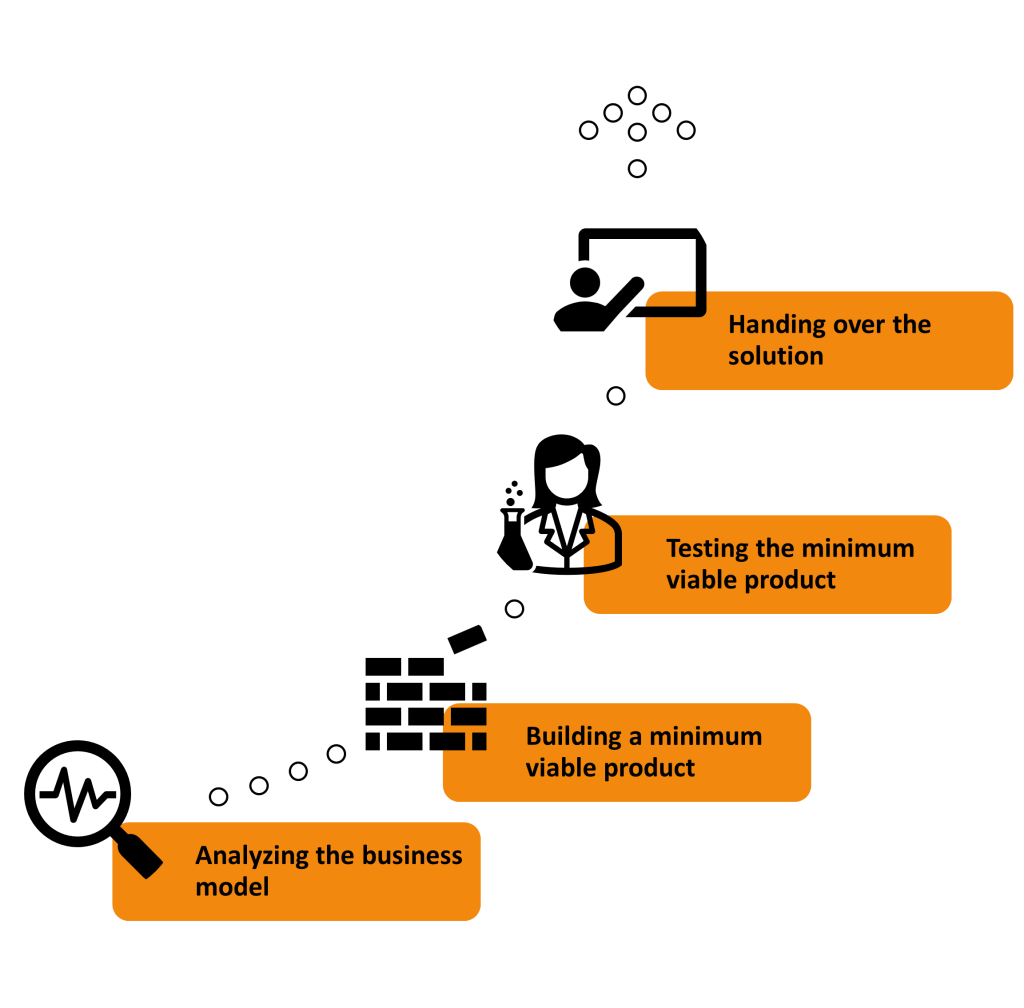
The SISTAC approach is designed to innovate in short cycles. In four key steps, our participants develop a workable solution for their start-up partner that should help the company grow and maximize its positive impact in its community.
Analyzing the business model. The first step is to understand and critically evaluate the partner’s business model. Thereby, „Shut up and listen“ to the other side should be the motto, because it takes a sound understanding of the customer needs before proposing a solution.
Building a minimum viable product. At the heart of the challenge lies the development of a so-called „Minimum Viable Product“, a version of the solution that possesses all the key functions and can be presented to target audiences to test its viability.
Testing the minimum viable product. In this step, we want to test the underslying assumptions of our solution. For example, if we propose a mobile app, we need to be sure that our target group even uses a mobile device. Through testing their solution under realistic conditions, our participants not only learn to observe and experiment, but also to fail early and pivot, if necessary. Hence, our method fosters an agile mindset and an evidence-based approach to impact-creating innovation.
Handing over the solution. Finally, it is time to present the impact start-up the final solution. So much for the official side. Often, the solution is not only accompanied by practical recommendations for implementation, but results in a long-term relationship between different people in different places around the world.
 sistac.world